Archives
-
Juni 2026
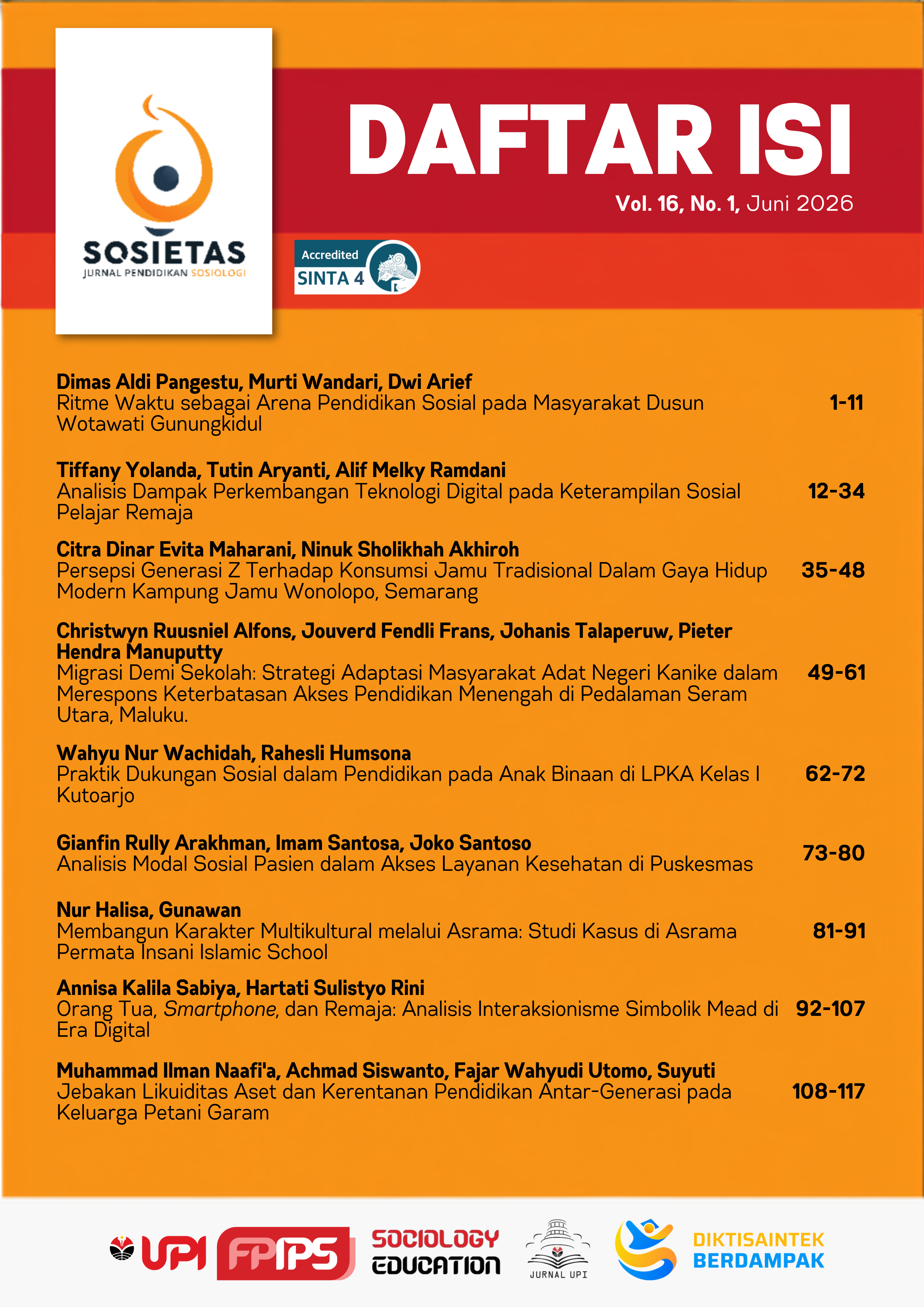
Vol. 16 No. 1 (2026)Sosietas Volume 16 Nomor 1 (2026) menghadirkan serangkaian artikel ilmiah yang secara kritis mengkaji dinamika struktur sosial, institusi, dan agen dalam ruang pendidikan dan pelayanan publik. Pada edisi ini, fokus interdisipliner teoretis diarahkan pada rekonstruksi pedagogis dan aplikasi teori-teori sosiologi makro maupun mikro dalam membedah isu-isu kontemporer di Indonesia.
Secara khusus, edisi ini mengeksplorasi bagaimana konsep sosiologi—seperti habitus, ranah, dan konversi modal (sosial, budaya, ekonomi, dan simbolik)—beroperasi dalam menjamin atau membatasi hak-hak marginal. Artikel-artikel yang tersaji mendalami dinamika praktik dukungan sosial dalam pemenuhan hak kependidikan anak binaan di Lembaga Pembinaan Khusus Anak (LPKA), serta menganalisis peran tri-dimensi modal sosial (bonding, bridging, dan linking) dalam menjembatani inklusivitas serta literasi digital masyarakat terhadap akses layanan kesehatan dasar di Puskesmas. Melalui pendekatan empiris yang kaya, edisi ini diharapkan dapat memberikan kontribusi teoritis yang signifikan bagi akademisi, sosiolog kependidikan, serta pemangku kebijakan publik dalam merumuskan transformasi sosial yang lebih inklusif dan emansipatoris.
Sosietas Volume 16 Number 1 (2026) presents a curated collection of scholarly articles that critically examine the complex dynamics between social structures, institutions, and agency within the spheres of education and public services. In this issue, an interdisciplinary theoretical focus is directed towards pedagogical reconstruction and the robust application of macro- and micro-sociological paradigms to dissect contemporary challenges in Indonesia.
Specifically, this volume explores how sociological tenets—most notably Pierre Bourdieu's social practice framework comprising habitus, field, and the conversion of various forms of capital (social, cultural, economic, and symbolic)—operate to either secure or constrain marginal rights. The published papers delve into the empirical realities of social support mechanisms governing the educational rights of juvenile inmates in Special Children’s Rehabilitation Institutions (LPKA). Furthermore, they scrutinise the tri-dimensional operation of social capital (bonding, bridging, and linking) in facilitating public inclusivity, digital literacy, and equitable access to primary healthcare provisions at community health centres (Puskesmas). Offering rich empirical insights, this issue aims to make a substantive theoretical contribution to academics, educational sociologists, and public policymakers in fostering more inclusive, adaptive, and emancipatory social transformations.